Scaling vs. Growing in 2026: Why Adding Isn’t Multiplying

Scaling

In the fast-paced business landscape of 2026, the words “growth” and “scaling” are often used interchangeably. However, as we navigate a year defined by AI-native operations and shifting global markets, confusing these two concepts can be the difference between a thriving enterprise and a collapsed startup.

What’s the Difference in 2026?

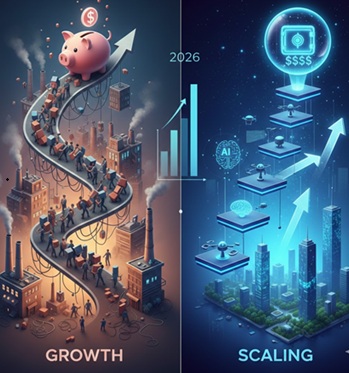
To put it simply, growth is linear. It’s the traditional model where your revenue increases at the same rate as your resources. If you want to double your sales, you double your team, your ad spend, and your office space. While growth is a sign of health, it’s also expensive and often hits a ceiling.

Scaling, on the other hand, is the holy grail of the modern era. It’s the ability to increase revenue exponentially while your operating costs remain relatively flat. In 2026, scaling is no longer just for “Big Tech”—it is the baseline requirement for any business using AI and cloud automation to handle increased volume without a proportional increase in “human” overhead.

Quick Comparison: Growth vs. Scaling

FeatureGrowthScaling
RevenueIncreases steadilyIncreases exponentially
CostsIncreases alongside revenueStays flat or grows slowly
FocusAdding resources (hiring/buying)Optimizing systems (automation/AI)
RiskModerateHigher, but more controlled with data

Why “Growth at All Costs” is Dead

In previous years, venture capital and market enthusiasm rewarded “growth at all costs.” In 2026, the market has matured. Investors and stakeholders are now prioritizing sustainability and efficiency.

Chasing growth without a scalable foundation leads to “bloated overhead.” This happens when your internal complexity grows faster than your profit, leading to burnout and quality dilution. Today’s winners are those who follow the “Scale Smarter, Not Harder” roadmap—using Phase 1 to build a foundation and Phase 2 to integrate AI-driven efficiencies that remove manual bottlenecks.

3 Pillars of Scaling in 2026

If you want to move from simple growth to true scaling this year, focus on these three strategic areas:

1. AI-Native Operations

In 2026, AI is no longer a “tool” you add to your workflow; it is the engine of the workflow. Scalable businesses are moving from “trying AI” to “using it well.” This includes:

  • Predictive Analytics: Using data to anticipate market shifts before they happen.
  • Agentic Workflows: Replacing repetitive manual tasks with AI agents that manage customer service, lead qualification, and even basic financial reporting.

2. Ecosystem Partnerships

The era of the “siloed business” is over. Scaling in 2026 often means building alliances. By partnering with technology firms or niche startups, you gain access to massive infrastructure without having to build it yourself. This “collaborative innovation” allows you to penetrate new markets (like the booming GCC region or climate tech) with minimal upfront capital.

3. Culture of “Less is More”

Ironically, scaling often requires doing less. It involves identifying your most repeatable, high-impact processes and stripping away the rest. High-growth companies are even experimenting with four-day workweeks while scaling, forcing teams to focus on outcomes over activity. When your systems are efficient, you don’t need more hours; you need better outputs.

Is Your Business Ready to Scale?

Before you hit the accelerator, ask yourself these three questions:

  1. Is my product-market fit validated? Scaling a flawed product only breaks it faster.
  2. Are my processes repeatable? If a task requires a “heroic effort” from a specific person every time, it isn’t scalable.
  3. Does my tech stack talk to itself? Integration is the key to efficiency. If your CRM doesn’t sync with your fulfillment or finance tools, you’ll drown in “data silos.”

The Bottom Line

In 2026, growth is a vanity metric; scaling is a sanity metric. While growth shows where you’ve been, scaling shows how far you can go without breaking. Whether you’re a startup or an established firm, the goal this year is to build systems that allow your revenue to soar while your stress—and your overhead—stays firmly on the ground.

Who we are: Funded.com is a platform that is A+ BBB accredited over 10+ years. Access our network of Angel Investors, Venture Capital or Lenders. Let us professionally write your Business Plan.

Unleashing Creativity: AI Strategies for Cutting-Edge Content

Content

In today’s digital landscape, leveraging artificial intelligence (AI) has become crucial for creating innovative and impactful content. AI tools can enhance creativity, streamline workflows, and help businesses stay ahead of the curve. However, using AI for content creation requires a strategic approach to ensure optimal results and avoid pitfalls. Here are six ways to pioneer creative content with AI the right way:

Understand Your Audience and Goals

Before diving into AI-powered content creation, it’s essential to have a clear understanding of your target audience and content objectives. AI can analyze vast amounts of data to identify audience preferences, trends, and behavior patterns. Use this insight to tailor your content strategy and create personalized experiences that resonate with your audience.

Choose the Right AI Tools

Not all AI tools are created equal, so it’s crucial to choose the right ones for your specific needs. Evaluate AI platforms based on factors such as their capabilities, compatibility with your existing systems, ease of use, and scalability. Look for tools that offer advanced features like natural language generation, image recognition, and predictive analytics to unlock creative possibilities.

Augment Human Creativity

AI should be viewed as a complement to human creativity, not a replacement. Encourage collaboration between AI systems and human creators to harness the best of both worlds. Use AI to automate repetitive tasks, generate initial concepts, and provide data-driven insights. Then, let human creativity take the lead in refining ideas, adding emotional depth, and ensuring authenticity.

Ethical and Responsible AI Use

As AI plays a more significant role in content creation, it’s crucial to prioritize ethical and responsible use. Avoid biases in AI algorithms by regularly auditing and refining them. Respect user privacy and data protection regulations when leveraging AI for personalized content. Transparently disclose AI involvement in content creation to maintain trust with your audience.

Iterate and Experiment

Embrace a culture of experimentation and continuous improvement when using AI for creative content. Test different AI models, content formats, and distribution channels to identify what works best for your audience. Collect feedback, analyze performance metrics, and iterate on your strategy based on insights gained from AI-driven analytics.

Stay Ahead of AI Trends

AI technology is rapidly evolving, so staying updated on the latest trends and advancements is crucial. Follow industry news, attend conferences, and engage with AI experts to learn about new tools, techniques, and best practices. Adopting emerging AI trends early can give you a competitive edge and unlock new opportunities for creative content creation.

By following these six strategies, businesses can pioneer creative content with AI in a way that maximizes its potential while ensuring ethical and responsible use. Embrace AI as a strategic ally in your content creation journey to drive innovation, engage audiences, and achieve meaningful results.

Who we are: Funded.com is a platform that is A+ BBB accredited over 10+ years. Access our network of Angel Investors, Venture Capital or Lenders. Let us professionally write your Business Plan.

How Artificial Intelligence can be a great startup Business

Artificial

You might have heard of rising of Artificial Intelligence, right? Owing to utmost advancement in technology, people observe novel inventions in science and technology that bring unknown changes in every field of life. One of the very changes that have taken place is the incorporation of Artificial intelligence in most areas of life. Since it has been primarily infused in multiple departments of our lives, we can do a great business out of it. This article has been written to cast light on its applications and how it can be a great business. So, let us start without further ado!

What is Artificial Intelligence?

Artificial Intelligence directs the capability of machines or controlled robots to perform specific tasks that are generally affiliated with intelligent or human beings. In simple words, Artificial Intelligence makes possible the simulation of human intelligence processes and functions by machines, particularly computer programs. Operations that AI performs are learning, planning, and problem-solving.

Typical examples of Artificial intelligence are the following:

  • Self-driving cars
  • Robo-advisors
  • Conversational Bots
  • Email spam filters
  • Smart assistants
  • Article spinning software

How does AI work?

Artificial Intelligence works by merging large sets of data with intelligent, mathematical, and programming processing logarithms to absorb patterns and features in the data being analyzed by AI systems. Artificial Intelligence applications can be gauged by their working and processing. AI enhances its performance and adds expertise by assessing and measuring its performance, each time performing a set of data processing.

Since it is operated through software, it does not need any break while calculating even thousands and millions of tasks exceptionally swiftly.

It still confuses you, right? But, essentially, AI consists of many computers to solve problems, making it an entire scientific discipline.

The critical goal of Artificial Intelligence and Robotics is to model human behavior. As a result, it can solve complex problems via human-like thinking processes.

To accomplish these problems, the AI system employs a whole series of strategies, techniques, processes, and a vast range of technologies.

What disciplines comprise the field of Artificial Intelligence?

Different components can also be referred sub-fields of the most crucial science of AI.

Each of these departments is generally employed by AI:

1-Machine learning:

AI has astounding applications in this field that enables computer systems, programs, and applications to learn and improve results based on experience automatically.

2-Deep learning:

It is a particular machine learning that permits Artificial Intelligence to learn and improve by processing data. Deep understanding utilizes artificial neural networks which imitate neural networks in the human brain to process.

3-Cognitive Computing:

It is another significant part of AI dedicated to mimicking the interactions between humans and machines. This incorporates text, voice, and speech AI parts.

4-Computer Vision:

One of the most prolific and applaudable uses of AI is to review and interpret the content present on the image with the help of pattern recognition and deep learning. For example, computer Vision allows AI systems recognize components of visual data like captchas you usually find on websites.

Common Applications of Artificial Uses:  

Although Artificial Intelligence applications are great in number in our natural world, we are presenting a few uses that we observe often:

1-Cyber-security:

AI plays the pivotal role of guarding against unauthorized attacks regarding important and susceptible data of an organization, be it private or governmental. The concept of Cybersecurity has been coined to cope with savage attacks from hackers, and AI plays an important in doing so for you. AI systems can detect cyberattacks and other cyber threats by monitoring the data that has been fed. Once this system detects a cyberattack, it can trace through your data to find the origin of the attack and help to prevent a potentially devastating failure.

2-Customer Relationship Management:  

Artificial Intelligence and Robotics are bringing massive changes to Customer Relationship Management systems. Since software involved in Customer Relationship Management like Zoho and Salesforce require considerable human intervention to run the system accurately, AI has great potential in carrying out such tasks. When you AI technology to these platforms, the CRM system advances to a self-updating, auto-correcting system that causes your CRM system to excel.

3-Internet and Data Research:

Artificial intelligence helps internet users to improve their search experience by affording them more relevant information about their inclinations and circumstances. As Artificial Intelligence technology advances swiftly, users get better and more customizable experiences.

4-Data Research Assistants:

AI has eliminated all the repetitive hassles of doing emails and answering common queries by completely changing the company operating from the inside. AI offers chatbots acting as personal assistants to assist manage your emails, maintaining your calendar, and even give you suggestions about smoothening processes. Moreover, these AI assistants can also help respond to questions customers ask who call or chat online.

We have summed up Artificial Intelligence Applications.

Why is AI business worthy of investing and what is its Future?

Having thoroughly read about this technology, you might have got some understanding regarding its bright future and demand. As technology progresses by leaps to bounds, the upcoming world will likely have much more crucial problems to contemplate and devise solutions to rather than doing simple routine tasks. Therefore, its future is very bright, and it will overwhelm the globe with its catchy features. Owing to its productivity, it will be a sought-after technology that is worthy of investment. The artificial Intelligence business is still soaring and will soar with more impetus, generating humongous revenues.

Funded.com is the leading platform for accredited investors network worldwide. We monitor and provide updates on important funding events. Angel Investors and Venture Funding can be a key growth for a startup or existing business. Whether it is a first, second or third round financing having a strategic alliance with an Angel Investor or Venture Capital financing can propel a business to the next level and give the competitive edge.